Notice: Function _load_textdomain_just_in_time was called incorrectly. Translation loading for the acf domain was triggered too early. This is usually an indicator for some code in the plugin or theme running too early. Translations should be loaded at the init action or later. Please see Debugging in WordPress for more information. (This message was added in version 6.7.0.) in /home4/rucativa/public_html/ssc2.pedroazambujavarela.net/wp-includes/functions.php on line 6170
Hanging models – Stereotomy Semantic Classification

Hanging models

Hanging models are simulations of a weighted net under gravity, also called, (stereo-)funicular models. Its functioning, clearly described by Hooker in the seminal quote โ€œas hangs the flexible line, so but inverted will stand the rigid archโ€[1], allows these kind of models to use flexible curves/ networks/fabrics that, using their own tension strength to carry a certain load, are morphologically vertically symmetrical to a solution strong in compression, successfully avoiding bending moments.

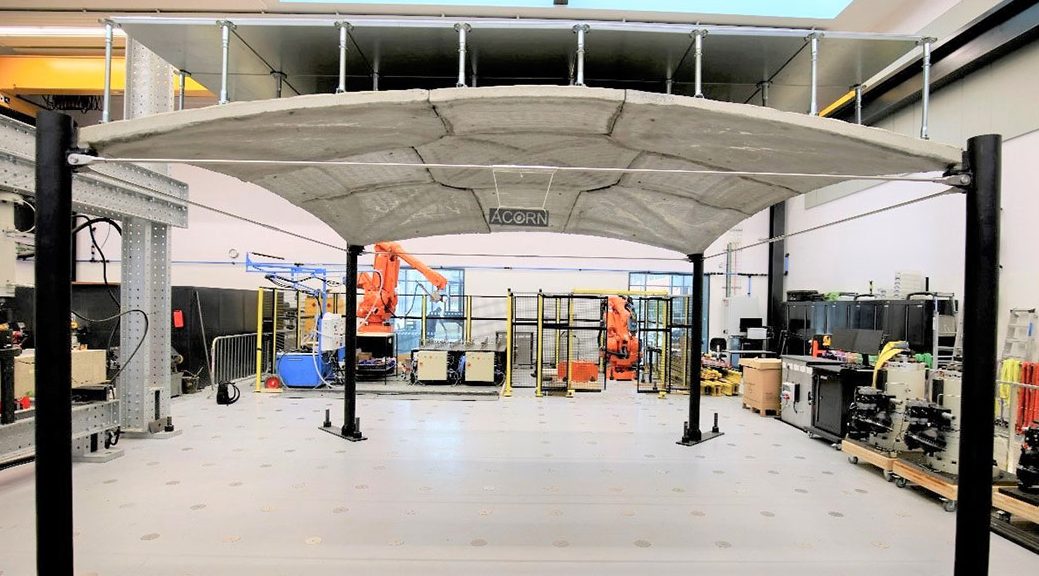
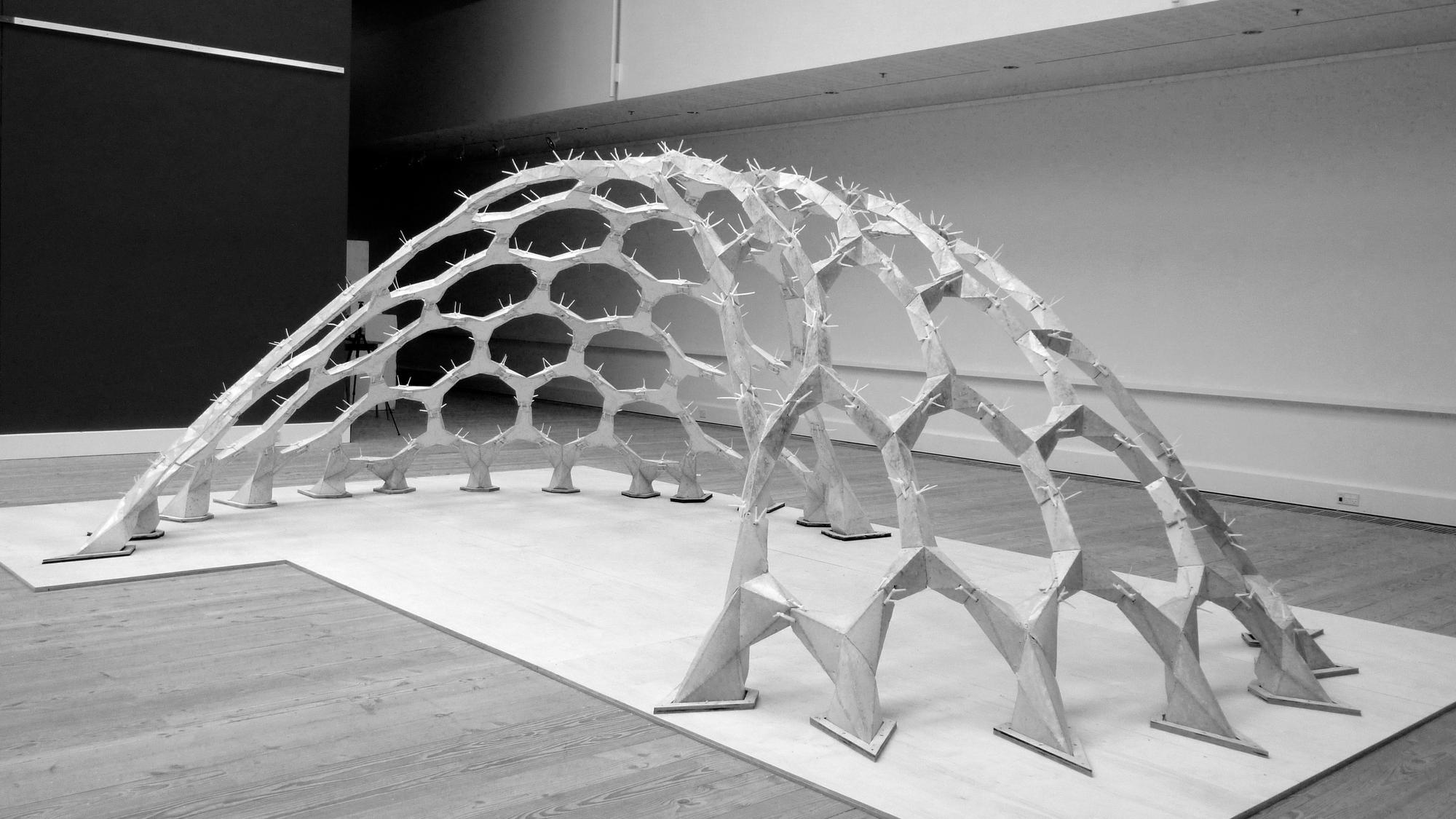
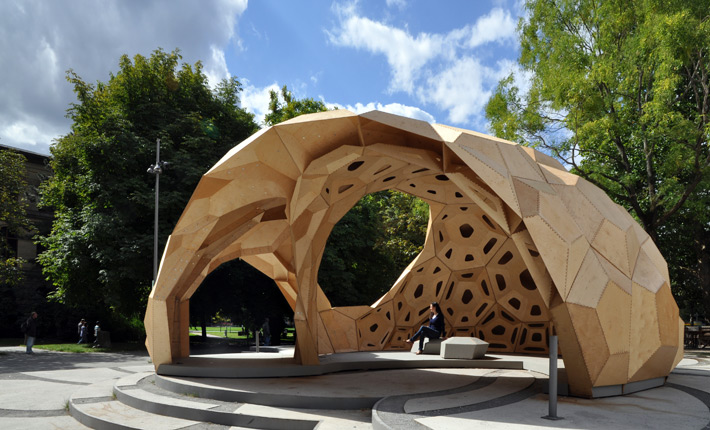
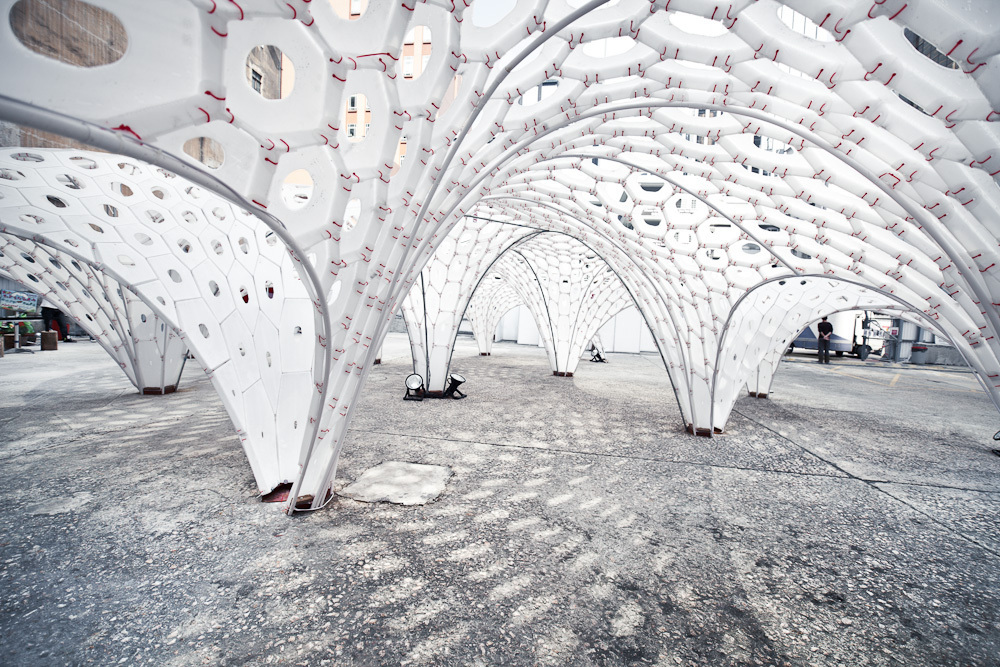
Before computation, architects such as Gaudi, Isler or Otto used this concept as a design tool for shells made of materials such as brick, concrete or wood. Computation tools[2] were created for a more comprehensive usage of hanging models, allowing for complex realizations which take advantage of computation such as Voussoir Cloud (Figure 81[a]) or PreVault (Figure 81[b]).

Computational hanging models are always based in a polygon mesh (a finite element surface representation). This mesh topology might be implemented in different approaches: a) the mesh topology is equivalent to the desired tessellation topology and the resulting hanging model contains in itself the final tessellation; b) the mesh topology resolution is very high so that the resulting hanging model reflects the thrust surface[3] as close as possible, which will serve as base for the ensuing stereotomic design.


[1] The original quote describing this catenary curve is the anagram โ€abccc ddeeeee f gg iiiiiiii Ilmmmmnnnnnooprr sssttttttuuuuuuuuxโ€, revealed only as โ€œUt pendet continuum fl exile, sic stabit contiguum rigidum inversumโ€ after Hookeโ€™s death by his will (Heyman, 1998, p. 79).

[2] See CADenary (A. Kilian et al., 2003) or Kangaroo (Piker, 2010).

[3] In an arch, the resultant of compressive forces lies within a line called the line of thrust. Stable structures contain this line within its mass. Similarly, in a three dimensional system, one can find a thrust surface where forces optimally flow.

Facets:

Show all Semantics
  • E Equilibrium

    • EA Macro-shape

      • EAA Generation method

        • EAAA Top down

          • EAAAA Constant generatrix

          • EAAAB Varying generatrix

        • EAAB Bottom up

          • EAABA Hanging models

          • EAABB Graphic statics

      • EAB Continuity

        • EABA Segmented

        • EABB Continuous

    • EB Structural functioning

      • EBA Compression only

      • EBB Compression and tension

        • EBBA Tension resistant voussoirs

        • EBBB External reinforcement

      • EBC Tension only

    • EC Surface subdivision

      • ECA One level subdivision

        • ECAA Pattern

          • ECAAA Periodic

            • ECAAAA Developable

            • ECAAAB Constant principal curvature

          • ECAAB Non-periodic

            • ECAABA Topological approach

              • ECAABAA Regular

              • ECAABAB Semi regular

            • ECAABB Space filling polygons

        • ECAB Performative subdivision

          • ECABA Curvature

          • ECABB Aesthetics

          • ECABC Voussoir dimensions

      • ECB Multiple level subdivision

        • ECBA Courses and voussoirs

        • ECBB Micro voussoirs within macro voussoirs

    • ED Foundation

      • EDA Site fixation

        • EDAA Pre-existing static base

        • EDAB Purposed static base

        • EDAC Tensioned springers

        • EDAD Wall or lintel supports

      • EDB Springer

        • EDBA Materiality

          • EDBAA Same as voussoir

          • EDBAB Different material

        • EDBB Geometry

          • EDBBA Subdivision continuity

          • EDBBB Specific design

  • T Tomotechny

    • TA Materialisation Processes

      • TAA Subtractive

        • TAAA 2D cut

          • TAAAA Milling (2D cut)

          • TAAAB Laser

        • TAAB 3D cut

          • TAABA Milling (3D cut)

          • TAABB Saw (3D cut)

          • TAABC Wire cutter

          • TAABD Water jet

        • TAAC 3D carve

          • TAACA Chisel and Mallet

          • TAACB Milling (3D carve)

          • TAACC Saw (3D carve)

      • TAB Additive

        • TABA Material extrusion

        • TABB Binder jetting

      • TAC Formative

        • TACA One-off Mould

        • TACB Reconfigurable Mould

    • TB Centering

      • TBA Temporary

        • TBAA Support structure below

          • TBAAA Extruded grid

          • TBAAB Per-Voussoir

          • TBAAC Along lines

        • TBAB Tensioned voussoirs above

      • TBB Permanent

      • TBC Inexistent (Centering)

        • TBCA Self supported

        • TBCB Additionally supported

    • TC Technical drawing method

      • TCA Two dimensional drafting

        • TCAA Trait

        • TCAB Descriptive geometry

      • TCB Three dimensional modelling

        • TCBA Computerized model

        • TCBB Computational model

  • V Voussoirs

    • VA Material

      • VAA Sustainability

        • VAAA Extraction

        • VAAB Transportation

        • VAAC Processing

        • VAAD Fabrication

      • VAB Structural performance

        • VABA Compression

        • VABB Tension

        • VABC Density

      • VAC Material Typology

        • VACA Subtractable materials

        • VACB Formable materials

        • VACC Additive materials

    • VB Intrados and Extrados

      • VBA Surface

        • VBAA Double Curvature

        • VBAB Single Curvature

        • VBAC Planar (Intrados and Extrados Surface)

        • VBAD Textured

      • VBB Perimeter

        • VBBA Concavity

          • VBBAA Convex

          • VBBAB Concave

        • VBBB Correspondence

          • VBBBA Analogous

          • VBBBB Differentiated

    • VC Contact surface

      • VCA Geometry

        • VCAA Ruled

        • VCAB Planar (Contact Surface)

        • VCAC Composite

      • VCB Friction

        • VCBA Smooth

        • VCBB Rough

      • VCC Mortar

        • VCCA Inexistent (Mortar)

        • VCCB Gap filling

        • VCCC Binding

      • VCD Interlock

        • VCDA Alignment

        • VCDB Sliding prevention

        • VCDC Cantilevering


Posted

by